

SECTION 1: Who This Is For?
Performance Level (Ages 14–18)
Build strength, power, and confidence for high-level performance.
Description:
This level is for athletes who are ready to train with intention.
Over 9 months, athletes learn how to move well, build strength safely, and apply that strength to explosive movements used in sport.
What You’ll Accomplish in 9 Months
By the end of this level, athletes will:
Move with confidence under load
Be strong in squatting, hinging, and pulling patterns
Generate explosive power from the hips
Catch and control force safely
Understand how to train, track, and improve their performance
Month 1 Goal: Improve back squat metrics (supporting front-squat strength & patterning)
Month 2 Goal: Improve thoracic/back strength (front-rack integrity + upright torso)
Month 3 Goal: Test front squat progress
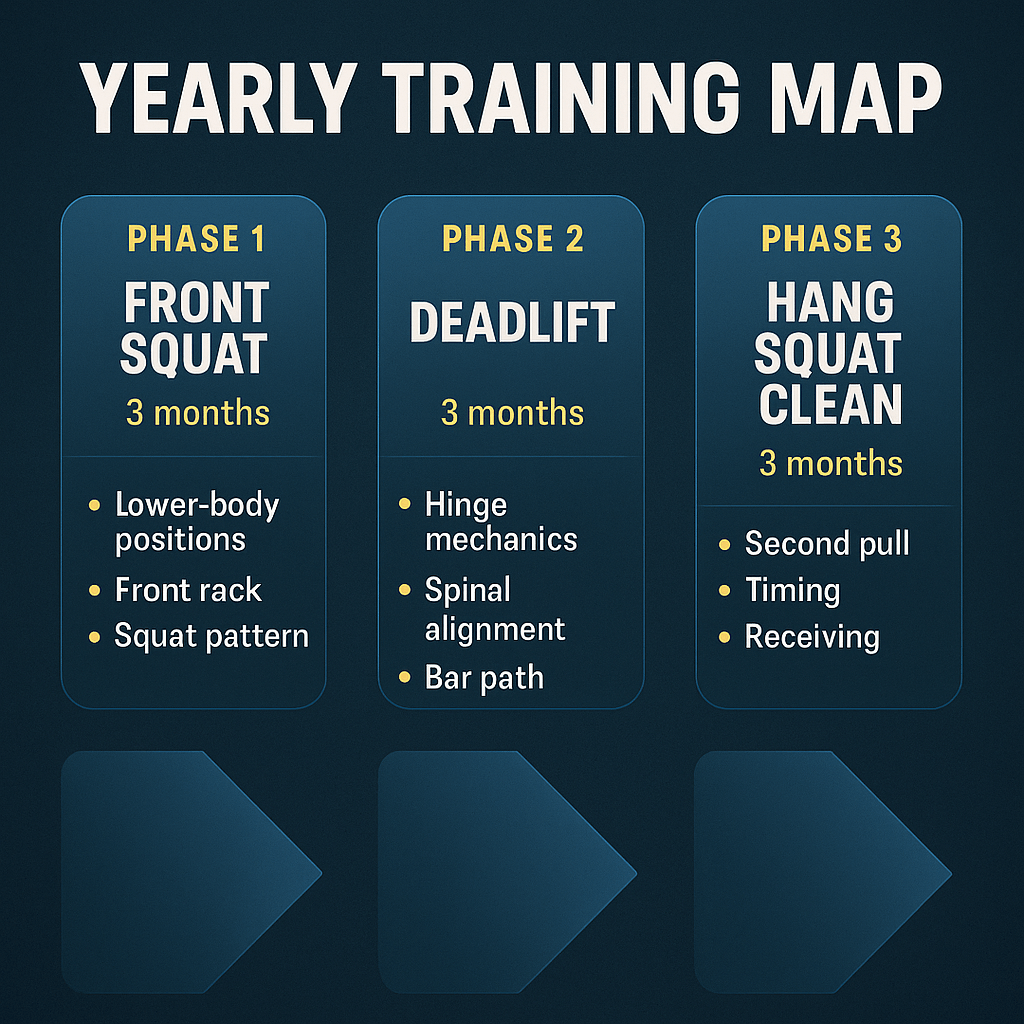
PHASE 1 (Months 1–3): Build the Base
Goal:
Get strong in the squat and build the posture needed for power.
What athletes focus on:
Getting stronger through the legs
Holding an upright torso under load
Improving upper-back strength
Simple outcomes athletes understand:
“I can squat with better form.”
“I feel stronger coming out of the bottom.”
“My upper back doesn’t collapse anymore.”
End-of-phase win:
You’re stronger, more stable, and ready to hinge and pull heavier weight safely.
PHASE 2 (Months 4–6): Build the Engine
Goal:
Develop strong hips and hamstrings so power comes from the ground up.
What athletes focus on:
Learning to hinge properly
Strengthening glutes and hamstrings
Pulling weight from the floor with control
Simple outcomes:
“My hips feel stronger.”
“My back stays tight when I lift.”
“I can pull weight without losing form.”
End-of-phase win:
You have the strength and control needed to create power.
PHASE 3 (Months 7–9): Apply Power
Goal:
Turn strength into explosive, athletic movement.
What athletes focus on:
Explosive hip drive
Strong leg drive into the bar
Catching weight with confidence
Simple outcomes:
“I feel explosive.”
“I can move weight fast and control it.”
“I’m confident catching the bar.”
End-of-phase win:
You can safely generate and receive power — the foundation for advanced Olympic lifting.
Each week follows the same rhythm:
Train
Record your work
Review progress
No guesswork. No random workouts.
Movement Standards
Set-Up
Tight front rack with full thoracic extension
Glutes + abs braced before descent
Shoulder-width stance with stable tripod foot
Descent
Smooth, vertical squat path
Torso stays nearly perpendicular
Bar travels straight down over midfoot
Bottom
Depth at or below parallel
Braced trunk — no flexion
Knees track consistently without wobble
Ascent
Drive vertically with knees and hips extending together
Elbows remain high
Bar path stays centered (no tipping forward)
PHASE 2: DEADLIFT — MOVEMENT STANDARDS + METRICS
(Ages 7–10 = Foundations • Ages 11–13 = Development • Ages 14–18 = Performance)
Purpose: Build maximal safe pulling strength, maintain speed of force, and prepare for power clean progression.
Movement Standards
Set-Up
Strong brace: ribcage-pelvis connection
Shoulders ~1–2 inches ahead of bar
Neutral spine from head to hips
Lats locked in to keep bar close
First Pull
Smooth floor break — no jerk
Knees extend as hips rise in sync
Bar stays over midfoot (no drifting forward)
Mid-Range / Knee Pass
Tight lats pull bar into thighs
Chest stays proud with stable trunk
No spinal flexion under fatigue
Lockout
Hips extend fully
Glutes finish the lift
No hyperextension / rib flare
Return
Hinge back under control
Bar stays in close path
No dropping from the top unless instructed for safety
Metrics (Ages 14–18)
1RM Strength Standards (General Athletic):
Solid: 1.5× bodyweight
Strong: 2.0× bodyweight
Elite HS strength: 2.25–2.75× bodyweight
(These scale with training age and bodyweight class)
Velocity Standard:
Working sets pulled ≥0.5 m/s for speed-strength blocks
Technique Pass/Fail:
No rounding under ≥85% 1RM
Vertical bar path
Stable knee tracking
Proficiency Benchmark:
Complete 3 heavy sessions at ≥85% with consistent brace, bar path, and clean lockout
MONTH 1 GOAL — Glute–Ham Strength (Strength-Focused)
Movement Standards
Weighted hip thrust: 6–10 reps
SL hip thrust: 6 reps per leg
GHR (full or band-assisted): 6–12 reps
Metrics
Hip thrust = 60–100% BW
SL thrust = no hip drop
GHR reps clean + controlled
Evaluation
Posterior-chain power score (0–3)
Must hit ≥2.5
MONTH 2 GOAL — Good Mornings (Strength Integration)
Movement Standards
Barbell on traps, strong brace
Clean hinge with stable shoulders
Torso reaches 45° without rounding
Bar path stays fixed
Metrics
3×8 @ 25–40% BW
Bar speed ≥ 0.6–0.8 m/s (if measured)
No torso collapse
Evaluation
5-category score (0–3 each):
Brace
Spine alignment
Bar stability
Hinge depth
Control
Passing = ≥11/15
MONTH 3 GOAL — Deadlift Test (1RM or 3RM)
Movement Standards
Explosive drive from floor
Vertical bar path
Torso + hips rise together
Clean lockout without overextension
Metrics
Strength target:
1.5–2.5× BW depending on age/training age
Peak bar velocity ≥ 0.5 m/s on working sets
No form breakdown >85% 1RM
Evaluation
Technical scoring (0–3 each):
Set-up
Bar path
Hip-knee sync
Lockout quality
Spine integrity
Passing = ≥12/15
PHASE 3: HANG SQUAT CLEAN — MOVEMENT STANDARDS + METRICS
(Ages 7–10 = Foundations • Ages 11–13 = Development • Ages 14–18 = Performance)
Primary Focus:
Second Pull Mechanics (hinge → extend → shrug)
Timing (legs → hips → shrug → pull under)
Receiving Position (front rack + squat)
Bar Path Control (vertical, close to body)
Movement Standards
Start Position (Mid-Thigh Hang)
Shoulders over bar
Bar in contact with thigh/crease
Full brace before movement
Dip + Hinge
Shoulders stay over bar until second pull
Bar stays tight to the thigh
No early hip rise
Second Pull
Violent triple extension
Bar tracks vertically
Arms bend AFTER legs finish
No reverse curl mechanics
Pull Under
Fast, aggressive rotation of elbows
Pull body under bar — not bar to body
Feet replant into squat stance
Catch + Recovery
Solid front rack, elbows high
Catch in deep squat with stable posture
Drive up with vertical torso
Metrics (Ages 14–18)
1RM Hang Squat Clean Targets:
60–85% of eventual power clean 1RM
Bar Speed Standard:
≥1.0 m/s during moderate-load reps
Consistency Criteria:
No crashing catch on ≥85% lifts
Bar Path Quality:
Within 3–4 cm from torso entire pull
Technical Pass/Fail:
Upright squat catch
Elbows through
Clean extension → late arm pull
Proficiency:
3 sessions hitting ≥80% with stable mechanics
MONTH 1 — HIGH PULL
Goal
Maximize second-pull power and vertical bar speed.
Movement Standards
Mid-thigh start
Violent triple extension
Bar travels vertically
Late arm pull
Shoulders + elbows rise aggressively
Metrics
3×5 @ 20–40% BW
Bar speed ≥ 1.3–1.6 m/s (if tracked)
No forward jumping
Evaluation
Timing (0–3)
Power output (0–3)
Bar path (0–3)
Passing = ≥7/9
MONTH 2 — PUSH PRESS
Goal
Develop overhead power for strong front-rack stability and force transfer.
Movement Standards
Dip vertical
Drive through legs
Fast punch to lockout
Bar finishes over midfoot
No backward lean
Metrics
3×5 @ 25–40% BW
Overhead hold stable for 1–2 seconds
Bar speed ≥ 1.0–1.2 m/s
Evaluation
Dip/drive sequencing (0–3)
Overhead stability (0–3)
Bar path (0–3)
Passing = ≥8/9
MONTH 3 — HANG SQUAT CLEAN TEST (1RM or 3RM)
Goal
Assess power, timing, turnover speed, and receiving position under meaningful load.
Movement Standards
Clean bar contact point
Full triple extension
Elbows whip through aggressively
Deep squat catch with vertical torso
Smooth recovery
Metrics
Strength target: 60–85% of Power Clean 1RM
Bar speed ≥ 1.0 m/s on moderate reps
No crash catches
Evaluation
5 technical categories (0–3 each):
Bar path
Extension timing
Turnover speed
Rack position
Squat receiving mechanics
Passing score = ≥12/15
Created with ©systeme.io